Melted: A Dripping Display Font for Edgy, Unconventional Design
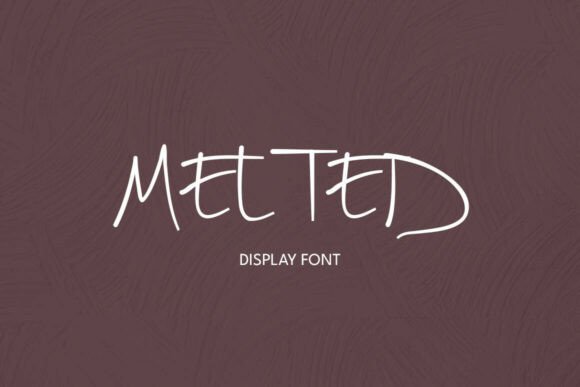
If you've ever stared at a perfectly set geometric typeface and felt a sudden urge to let it all drip down the page, you're not alone. There's a powerful creative impulse to break free from rigid grids and embrace something more visceral, more human. That's the exact energy that Melted brings to the table. This isn't your typical clean-cut display font; it's a liquid, dripping typeface that feels like it was drawn with a shaky hand and a lot of attitude. Its monoline paths and wildly swaying baselines give words a loose, continuous signature posture, mimicking the natural flow of melting ink or shifting fluid. For designers and creators tired of playing it safe, Melted offers a direct pipeline to a raw, counter-culture aesthetic that’s impossible to ignore.
Why This Typeface Feels So Alive
What makes Melted stand out in a sea of premium fonts is its beautifully chaotic anatomy. Forget about even character widths and predictable spacing. Here, each letter has its own personality, with sweeping swashes that connect letters in a way that feels organic and spontaneous. Yet, despite its wild appearance, the font is crafted with high-clarity outlines. This is a crucial detail—it means you can layer this creative font over dense background textures, dark color fields, or abstract editorial designs without losing legibility. It strips away unnecessary complexity to deliver maximum impact, which is a godsend when you're working on complex visual projects.
Think about the last time you needed a design to feel rebellious, punk, or authentically gritty. Maybe it was for an indie music album cover, a skate brand's merchandise, or a horror-themed gaming interface. Standard sans serif fonts can feel too corporate, and many script fonts can lean too elegant. Melted occupies that perfect niche of underground movie titles and alternative streetwear labels. It’s the typographic equivalent of a spray-paint can or a marker pen running low on ink—full of character and movement.
Putting Melted to Work: Real-World Applications
So, where does this liquid dripping display font actually make sense? Its applications are surprisingly broad, provided your goal is to inject energy and a hand-made feel. For branding, it’s a standout choice for businesses that want to position themselves as edgy, youth-focused, or artisanal. Imagine a craft brewery using it for a limited-edition stout label, or a vegan food truck with a rebellious streak using it for their logo. It instantly communicates that a brand doesn't take itself too seriously and values creativity over conformity.
In the realm of packaging design, Melted can transform a simple product into a collectible. Think of custom sticker layouts for a laptop or skateboard deck, or the branding on a line of hot sauces. The font’s organic, chaotic look makes it perfect for products that are themselves about bold flavor or intense experience. For social media graphics, it’s a secret weapon for stopping the scroll. A bold headline set in Melted on a Instagram story or a TikTok video thumbnail immediately sets a different tone than a polished corporate font. It’s ideal for promoting underground events, podcast episodes about niche topics, or artist collaborations.
Don’t overlook its power in editorial design and web design either. Used sparingly, as a headline or pull quote on a blog or magazine layout, it can break up the monotony of body text and inject a shot of adrenaline into the page. For a music blog reviewing punk albums or a zine covering street art, Melted as a display font for titles can reinforce the site’s core identity. It’s a typeface that tells a story before the reader even processes the words.
Smart Strategies for Using a Bold Typeface
Working with a font as expressive as Melted requires a bit of strategy. The golden rule is contrast and restraint. Because it’s so visually loud, it almost always works best as a headline or accent font, paired with a more neutral companion. Trying to set a full paragraph in Melted would be a readability nightmare. This is where understanding font pairing becomes essential.
A great approach is to pair this handwritten font with a clean, geometric sans serif font for body text. The simplicity of the sans serif will let the Melted headline shine without competing for attention. Alternatively, for a more layered, editorial feel, you could pair it with a sturdy serif font to create a dynamic tension between the raw and the refined. Always test your pairings by looking at them at the actual size they’ll be used. What looks cool in a large mockup might become illegible when scaled down for a website header.
Also, pay close attention to the background. Melted’s strength is its ability to sit on top of textures and images, but you still need to ensure enough contrast. Adding a slight drop shadow, placing it over a semi-transparent color block, or choosing a background image with a relatively uniform area can make all the difference. Remember, readability is still the ultimate goal, even with an artistic font.
Making It Part of Your Design Toolkit
Before you dive in, take a moment to review what’s included with the font. A quality premium font like this often comes with different styles or weights—maybe a regular, bold, or italic version. Understanding these options gives you more flexibility. You might use the bolder version for a product title and a lighter weight for a secondary tagline. Also, check for any alternate characters or ligatures that can add even more variety to your typesetting.
Finally, and this is non-negotiable for any commercial project, always check the licensing. Whether you’re a freelancer designing for a client or a business owner creating your own marketing assets, you need to ensure the font’s license covers your intended use. Most reputable foundries offer clear licensing for desktop, web, app, and server use. Investing in a properly licensed commercial font protects you legally and supports the independent type designers who create these unique tools.
In the end, Melted is more than just a display typeface; it’s a statement. It’s for the projects that need to feel handmade, urgent, and a little bit dangerous. It’s a tool for visual communication that prioritizes emotion and energy over sterile perfection. If your next project calls for that kind of raw, unconventional power, letting your typography drip might be the best move you make.